
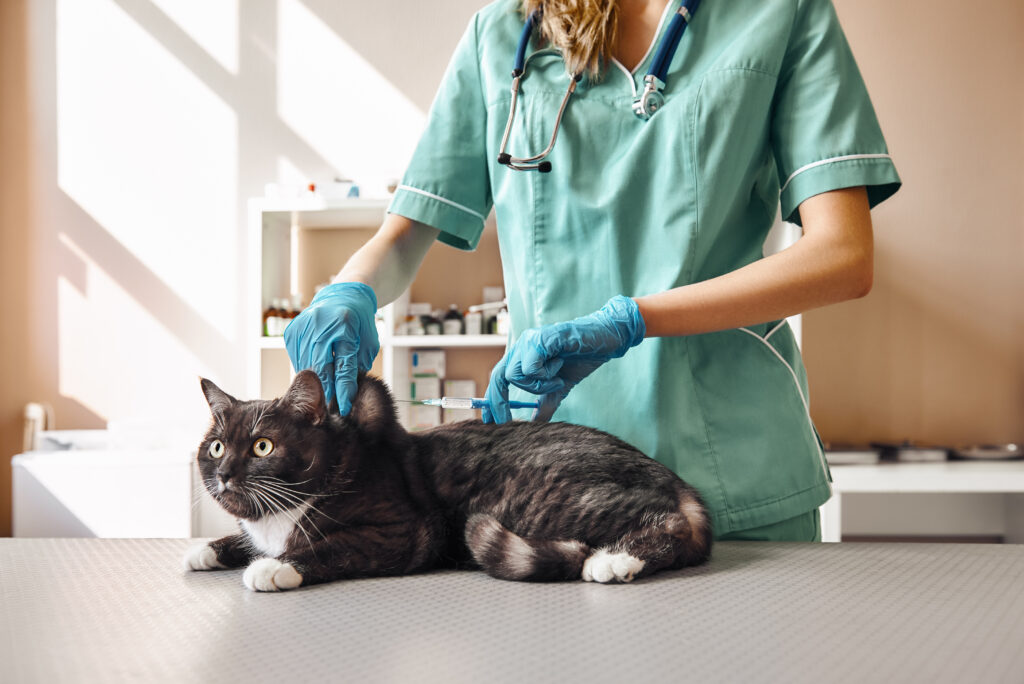
As I practice a ‘natural’ therapy (acupuncture) on my patients, I meet a lot of pet owners who are mistrustful of conventional medicines. The subject of vaccination comes up and I am sometimes asked what I think, although more often a pet owner has come to their own judgement long before I appear on the scene. However, as in most spheres of life these days, there is a lot of misinformation out there being presented as fact so I thought I would run through some of the pros and cons of vaccinations based on the science.
According to the World Health Organisation (WHO), vaccination is a simple, safe, and effective way of protecting against harmful diseases, before the body comes into contact with them. It uses the body’s natural defences to build resistance to specific infections. Vaccines train the immune system to create antibodies, just as it does when it’s exposed to a disease. However, because vaccines contain only killed or weakened forms of germs like viruses or bacteria, they do not cause the disease or put the patient at risk of its complications. Sometimes, vaccines contain ‘adjuvants’, that is, extra ingredients designed to ‘prod’ the immune system into responding more vigorously (i.e. producing more antibodies) than they would without these ingredients, meaning there is a more effective or longer-lasting protection. It is often these adjuvants that gain attention, as they have in the past included heavy metals such as mercury or aluminium.

I've heard lots of bad stuff about side-effects....
A lot has been made of vaccine side-effects because they hit the media headlines, but in the vast scheme of the millions of people and animals who have been vaccinated, serious or long-lasting side effects are extremely rare. For example, a recent scientific paper which traced 99 billion people across the globe who received COVID-19 vaccination, it revealed 48 extra cases of blood clotting on the brain than would be expected in an unvaccinated population (1). Now of course this is awful if you or a loved one are one of the 48, but in the global picture of many millions of deaths prevented by COVID-19, the vaccination programme was still an overwhelming success.
And that is the nub of the vaccination issue: we are all interested in our own (or our pets’) safety, not that of the global population, and yet the great value of vaccinations is for population health. We have seen that when misinformation about the childhood MMR vaccine was published, many concerned parents opted to do what they thought was the safest thing for their child, and this has led to a spike in measles-related illness in the UK for many years since.

Your vet may have a different perspective than you - for good reason
I remember vividly my time as a vet student in Liverpool, having a post-mortem examination being demonstrated on a German Shepherd dog that had died from leptospirosis. Every tissue in that dog was bright yellow as a result of the jaundice brought on by liver failure. Most vets my age and older will have had experience of trying to treat young unvaccinated pups with parvovirus, their limp bodies unresponsive to the fluids being pumped into them and the intensive care of the dedicated nurses and the smell of the fluid leaking out of them…..building yourself up to call the owner and let them know all our efforts to save them have been in vain…..scenes like these never leave your memory. It is difficult NOT to recommend vaccination for these diseases when such cases could have been prevented.
Sadly, bad news spreads faster and sells more ‘clicks’ than good news, so any possible reactions or bad side-effects tend to make it into the (social) media headlines well before they have been properly established. Rarely are the full facts of the case made public – was this animal in fit and full health? Were there other factors at play in the animal’s response? For this reason it is ESSENTIAL to report any suspected reactions to the Veterinary Medicines Directorate via their yellow card scheme so that such reactions can be properly collated and any links established. This is the only way that medicines can be made safer, for example a certain subset of the population may be more susceptible to a side-effect, and if properly established this can be added to the licensing information and disseminated to veterinary professionals so that they can give the correct advice. No vet would be able to justify to their professional regulatory body (the Royal College of Veterinary Surgeons) giving advice based on a post from a Facebook group entitled “My dog was given X and then they died”. Can you see the dilemma?
What are the risks for *your* pet?
Consider the risks of NOT vaccinating your pet, alongside the risks that may come with giving it. If you have a single elderly cat that never leaves the house, their risk of coming into contact with infectious diseases is minimal. If you have a young active dog that is visiting the park and walking the pavements several times a week, the risk is much greater. If they have access to watercourses such as canals or ditches where rats may be present, their risk of contracting leptospirosis is much higher than a dog who just does a turn of the block once a day.
Secondly, consider the necessary frequency of vaccination. The World Small Animal Veterinary Association (WSAVA) guidelines (2) have been drawn up by specialists in veterinary immunology and infectious diseases, and recommend different intervals for different vaccines, according to the data we have on how long protection lasts. It is NOT recommended to give ‘everything’ every 12 months, but for some vaccines (such as leptospirosis, which is a ‘dead’ vaccine) it IS important to repeat it otherwise protection will wane to an ineffective level. We used to only have a ‘5 in 1’ or ‘6 in 1’ product available for dog vaccinations, but now thankfully we have many more combination options which can allow us to follow the science, rather than a programme dictated by vaccine manufacturers.

So what does the science say?
In the UK, the standard recommendation from the WSAVA is to give certain ‘core’ vaccines to dogs as standard: these are distemper virus, adenovirus (hepatitis), parvovirus and leptospirosis. Rabies, kennel cough and others should be considered on individual risk factors. Young animals need several vaccinations because they already have antibodies in their bloodstream from their mother’s milk which can last up to 12-16 weeks of age. These antibodies can render the vaccine useless as they destroy the weakened germ before their own immune system has a chance to respond, and so they have no ongoing protection. After that, the recommendation is every 3 years for distemper, hepatitis and parvovirus.

So why is my vet still saying I need to bring my pet in for vaccinations every year?
There are three good reasons for this:
1) the value of an annual health check. This is a chance to ask your vet if something is bothering you, and for your vet to assess heart and dental health, weight or pick up any disease processes in the early stages. It may be a false economy to skip this opportunity.
2) as we mentioned above, not all vaccines last 3 years. Leptospirosis is a ‘dead’ vaccine and protection will wane after 12 months. Leptospirosis cases have increased since vaccination rates have reduced (3). Feline leukaemia virus is another.
3) some pets may miss a vaccination due to owner circumstances, or illness, or not have enough protection if they finished their vaccine course too early as a pup or kitten before those maternal antibodies had disappeared. Inviting you to bring your pet once a year can help to catch those outliers and ensure they are protected too.
It is possible to test for antibody levels to some diseases to see if repeat vaccination is required, but this is not appropriate for all – sometimes antibody levels are no guarantee of protection. Your vet should be able to advise you on this if that is your preference – and if it is, please do still make use of the annual health check for your pet.
At the end of the day, vaccination is an individual decision for each and every pet owner, but it is vital you are making a decision with as much reliable information as possible. When considering vaccination for your own pet, talk to your vet about your concerns. Most should not be dismissive but help you to come to a decision you are happy with.
- https://doi.org/10.1016/j.vaccine.2024.01.100.
- https://wsava.org/Global-Guidelines/Vaccination-Guidelines/
- https://www.veterinary-practice.com/2024/davies-confirms-significant-increase-in-leptospirosis-cases
Photo credits: Cat vaccination – Friends Stock on Adobe Stock; Lab worker – chokniti on Adobe Stock